

La Grande Gold Project, James Bay, Québec
Lux Metals' flagship La Grande Gold Project sits in the heart of Québec's James Bay region, one of Canada's most active gold and lithium exploration districts. The Project is anchored by Zone 32, a high-grade gold system where over 40,000 metres of historic diamond drilling, supported by extensive surface sampling and geological mapping programs, have outlined gold mineralization across 600 metres of strike length and 350 metres of vertical depth, with the system remaining open along strike and at depth.
Headline historic drill intercepts at Zone 32 include 83.8 metres at 7.95 g/t Au, 38.5 metres at 4.32 g/t Au, and 36.0 metres at 3.37 g/t Au — wide intervals of consistent grade across multiple drill campaigns.
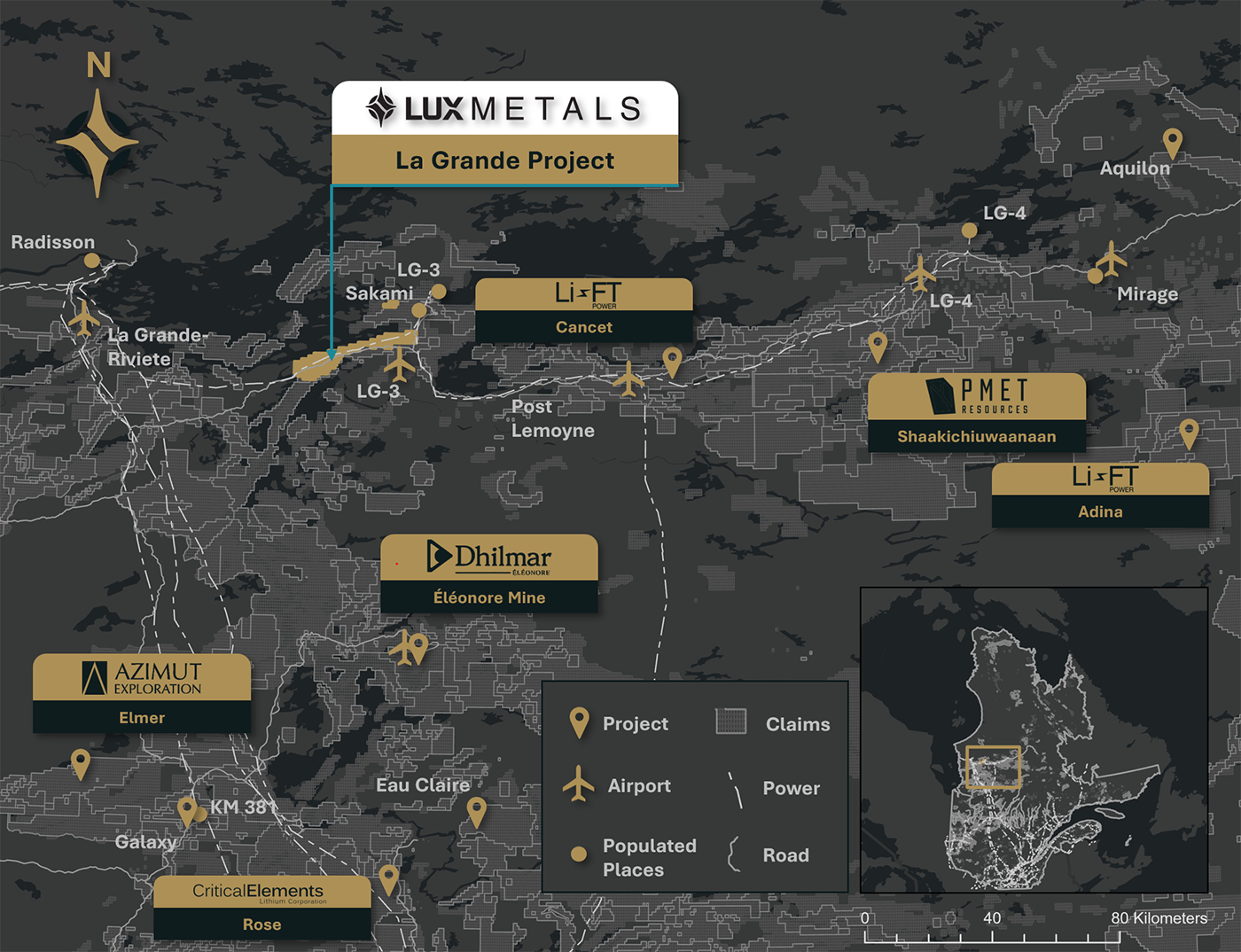
Located approximately 85 kilometres southeast of Radisson, La Grande benefits from year-round road access via the all-season Transtaiga Road, an adjacent Hydro-Québec airstrip, and a high-voltage power line crossing the Property, providing direct access to grid power in a region where many exploration-stage projects lack electrification. The Project sits within the same regional belt as the producing Éléonore gold mine.
The technical content of this page is supported by the NI 43-101 Technical Report on the La Grande Project dated January 12, 2026, prepared by Martin Aucoin, M.Sc., P.Geo. (independent) and Jonathan Marleau, M.Sc., P.Geo. of Dahrouge Geological Consulting Ltd.
Where is the La Grande Gold Project located?
La Grande sits in the Eeyou Istchee James Bay region of Québec, Canada — a top-tier mining jurisdiction with a long track record of gold and lithium discovery. The Property lies approximately 85 kilometres southeast of Radisson, the regional service hub, and is transected by the all-season Transtaiga Road.
The Project's location delivers genuine operational advantages most exploration-stage projects cannot match:
- Year-round road access via the Transtaiga Road
- Hydro-Québec's LG-3 airstrip directly east of the Property, with the Sakami Camp 10 kilometres away
- A Hydro-Québec high-voltage power transmission line crossing the Property
- Helicopter support available year-round from Radisson
- Position within the same regional belt as the producing Éléonore gold mine
What is the Zone 32 gold system?
Zone 32 is the high-grade core of the La Grande Project — and the foundation of Lux Metals' exploration strategy.
600 metres along strike. 350 metres at depth. Open in all directions.
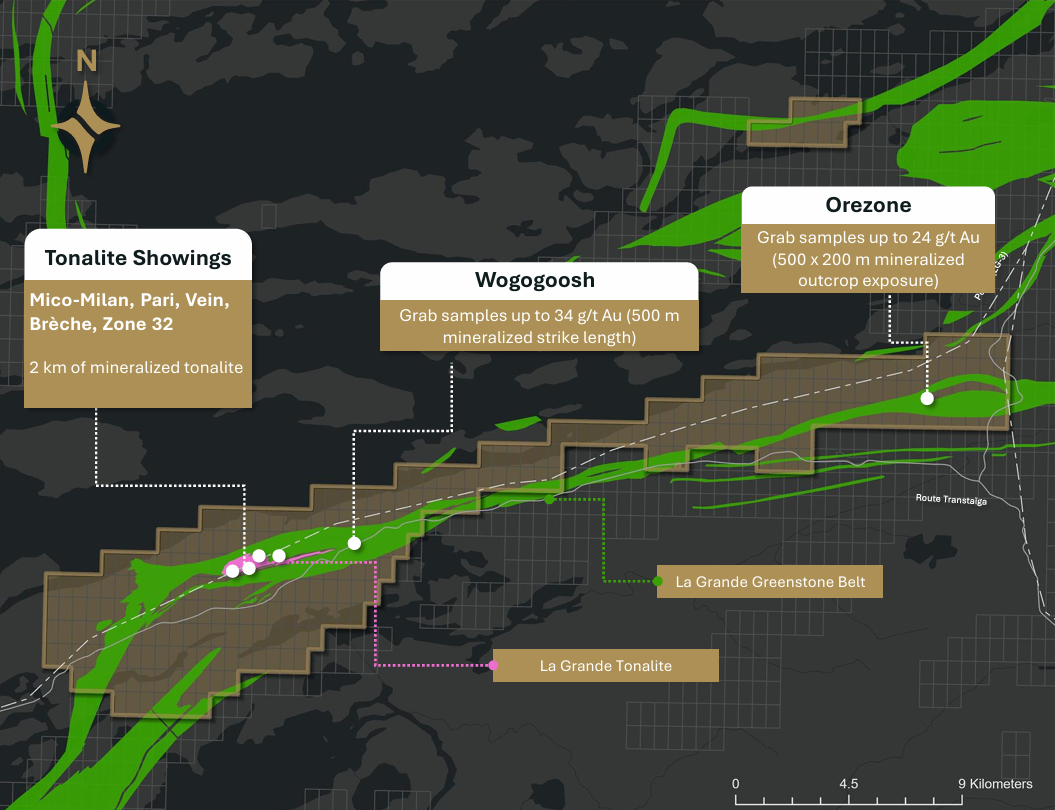
Decades of historic exploration delineated a shear-hosted gold mineralized envelope at Zone 32 that extends 600 metres along strike, 350 metres in vertical depth, and approximately 300 metres in horizontal width. The deposit remains open along strike, at depth, and laterally — a profile rare among advanced exploration-stage gold projects.
Zone 32 is hosted within the La-Grande-Sud Tonalite, a synvolcanic felsic intrusion dated at 2,734 ±2 million years old. The deposit sits in a regional shear corridor that separates the tonalite from the surrounding mafic volcanic rocks of the Yasinski Group, a setting consistent with established Archean orogenic gold deposit models that have produced multi-million-ounce camps elsewhere in the Superior Province.
Mineralization occurs in three principal styles:
- Disseminated sulphides within deformed tonalite
- Quartz-tourmaline carbonate veins associated with sericite-chlorite alteration
- Sulphide veinlets ranging from millimetre to centimetre scale
Adjacent and related zones, all situated within or near the same structural corridor, include the Hanging Wall, Footwall, Pari, Brèche, Mico-Milan, and Vein zones. Zone 30 represents the down-plunge depth extension of the Zone 32 system. Zone 103 lies immediately north of Zone 32 — together they form a coherent mineralized system that has been the focus of historic exploration over more than three decades..
What gold grades have been intersected at La Grande?
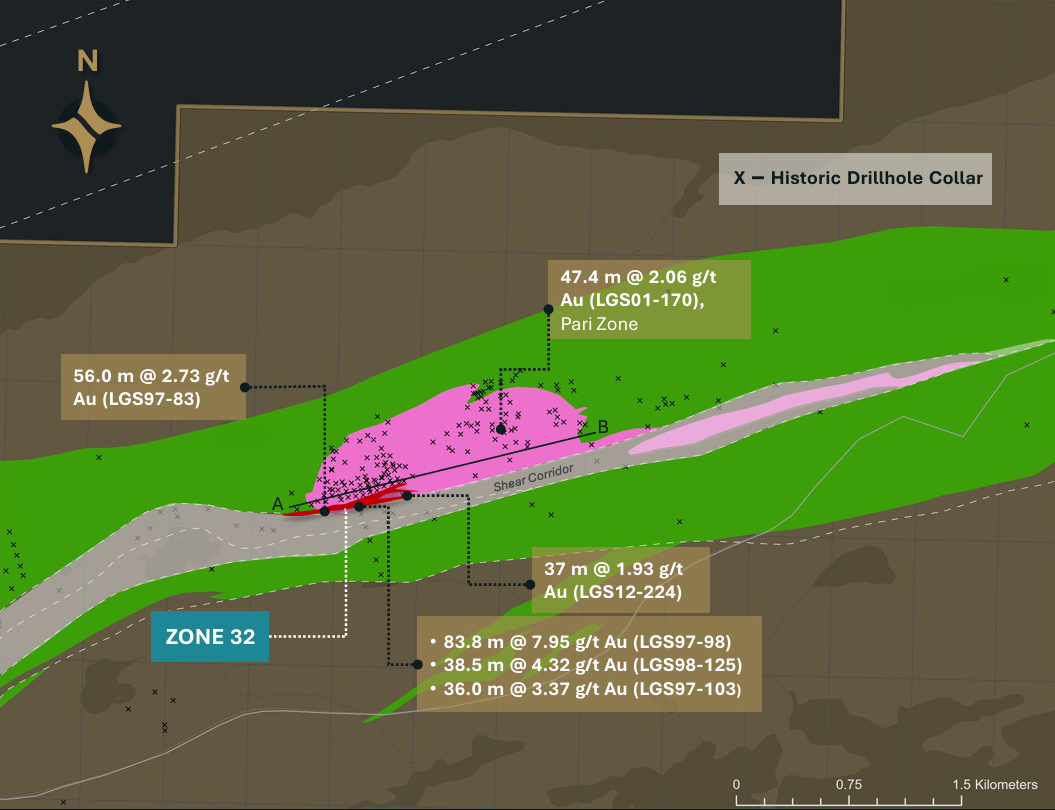
Over 40,000 metres of historic diamond drilling at the Zone 32 corridor have repeatedly delivered wide intervals of high-grade gold mineralization. Headline intercepts include:
- 83.8 metres at 7.95 g/t Au (LGS97-98)
- 56.0 metres at 2.73 g/t Au (LGS97-83)
- 47.4 metres at 2.06 g/t Au (LGS01-170, Pari Zone)
- 38.5 metres at 4.32 g/t Au (LGS98-125)
- 37.0 metres at 1.93 g/t Au (LGS12-224)
- 36.0 metres at 3.37 g/t Au (LGS97-103)
These results were generated across multiple drilling programs by previous operators of the property over more than two decades. Mineralization has been confirmed from surface to a vertical depth of approximately 300 metres in the main Zone 32 envelope.
The system extends well beyond the currently defined envelope.
One drill hole in particular highlights the discovery upside: LGS12-224 intersected 1.93 g/t Au over 37 metres approximately 400 metres down-plunge from the main Zone 32 mineralization, demonstrating that the gold-bearing system continues at depth — and that significant volumes of mineralized rock remain to be tested.
HISTORIC DRILLING DISCLAIMER
The historic drill results disclosed on this page were generated by previous operators of the Property. The independent qualified person, Mr. Martin Aucoin, M.Sc., P.Geo., conducted a site visit on January 6 and 7, 2026, during which he inspected drill core from a representative subset of mineralized intervals and confirmed that the inspected widths and depths are consistent with the drill hole database. The qualified persons consider the drilling database to be internally consistent and generally reliable, though QA/QC documentation prior to 2003 is incomplete.
What is the geology of the La Grande Project?
The La Grande Project sits in the Superior Province of the Canadian Shield, on the boundary between the La Grande and Opinaca subprovinces — geological territory that hosts some of Canada's most productive Archean gold districts.
The Property hosts a complex Archean geological sequence including:
- The La-Grande-Sud Tonalite — a synvolcanic felsic intrusion dated at 2,734 ±2 million years old, host to the principal Zone 32 mineralization
- The Yasinski Group (2,732 to 2,740 million years) — a thick volcano-sedimentary sequence dominated by basalt
- The Laguiche Complex — metasedimentary rocks of the Opinaca Subprovince
- The Langelier Complex — basement gneissic tonalite dated up to 3,452 million years old
Mineralization at La Grande is interpreted as a shear-zone, intrusion-hosted Archean orogenic gold system. Gold precipitated during regional deformation when CO2-rich metamorphic fluids migrated along reactivated shear zones, depositing gold in structurally prepared zones characterised by sericite-chlorite alteration, disseminated and vein sulphides, and quartz-tourmaline carbonate veining. This is the same deposit family responsible for many of the Superior Province's largest gold camps.
What's next at La Grande?
Lux Metals is preparing the next chapter of exploration at the La Grande Gold Project. An approximately 5,000-metre drill program is contemplated for later in 2026, focused on advancing the Zone 32 corridor and testing additional targets identified through the Company's ongoing review of the historical project database.
Exploration work annual planning
Further details regarding the exploration program will be released in due course. Subscribe for shareholder updates to follow the Company's progress.
FORWARD-LOOKING DISCLAIMER
The exploration program described above is contemplated for later in 2026 and is subject to permitting, financing, regulatory approvals, and final program design. There is no guarantee that exploration activities will result in the delineation of an economic ore body.
Who is behind the La Grande Gold Project?
La Grande is backed by a management team with deep operational experience across the mining value chain and direct familiarity with the James Bay region. The team's combined credentials span senior roles at major producers including Goldcorp, Rio Tinto, Fortescue Metals Group, and Newmont Corporation, with direct operational experience at the Eleonore Mine in James Bay. Leadership expertise extends across exploration geology, mine operations, capital markets, and public company finance, with multiple members holding professional geological and accounting designations.
The Company's geological work is led by Dahrouge Geological Consulting, one of the most recognised exploration firms operating in Quebec, with a well-established operational presence in James Bay spanning nearly two decades.
Dahrouge's team was instrumental in the discovery of Patriot Battery Metals' Corvette lithium deposit, , and the firm continues to lead exploration programs for multiple operators across the district. Bringing firsthand knowledge of the regional geology, logistics, and exploration best practices that define successful programs in James Bay.
How is La Grande positioned in the James Bay district?
The La Grande Project sits in the heart of one of Canada's most active mining and exploration districts. The James Bay region of Québec has attracted billions of dollars of investment over the past two decades, anchored by the producing Éléonore gold mine to the south of La Grande and a growing roster of advanced lithium and gold projects.
Notable regional projects include the operating Éléonore gold mine (Dhilmar Ltd.) and lithium projects from Critical Elements Lithium Corporation, Patriot Battery Metals, and Winsome Resources.
Who is the Qualified Person for the La Grande Project?
The technical content of this page is supported by the NI 43-101 Technical Report on the La Grande Project dated January 12, 2026, prepared by two qualified persons of Dahrouge Geological Consulting Ltd.:
- Mr. Martin Aucoin, M.Sc., P.Geo. (OGQ #0989) — independent of Lux Metals Corp. Mr. Aucoin visited the Property on January 6 and 7, 2026, and is responsible for and takes responsibility for all sections of the Technical Report.
- Mr. Jonathan Marleau, M.Sc., P.Geo. (OGQ #2277) — co-author of the Technical Report.
The full Technical Report is available on SEDAR+ under the Lux Metals Corp. profile.
Frequently asked questions
Q: What is the La Grande Gold Project?
A: La Grande is the flagship gold project of Lux Metals Corp. (TSXV: LXM), located in Québec's James Bay region. The Project hosts the high-grade Zone 32 system, where over 40,000 metres of historic diamond drilling have outlined gold mineralization across 600 metres of strike and 350 metres of vertical depth, with the system remaining open in all directions.
Q: What is the highest gold grade reported at La Grande?
A: The headline historic intercept is 83.8 metres at 7.95 g/t Au, drilled in hole LGS97-98 at Zone 32. Other notable intercepts include 38.5 metres at 4.32 g/t Au (LGS98-125) and 36.0 metres at 3.37 g/t Au (LGS97-103). Investors are reminded that historical drill results were not produced under current standards.
Q: How big is the La Grande Project?
A: The Project comprises 300 Exclusive Exploration Rights covering 15,357.35 hectares in two contiguous blocks across approximately 40 kilometres of prospective Archean greenstone belt.
Q: When will Lux Metals begin drilling at La Grande?
A: Lux Metals is planning an approximately 5,000-metre drill program contemplated for later in 2026, subject to permitting, financing, and final program design. Refer to the Company's news releases for current updates.
Q: What is the deposit type at La Grande?
A: Zone 32 is interpreted as a shear-zone, intrusion-hosted Archean orogenic gold system, hosted within the La-Grande-Sud Tonalite and the contact corridor with the surrounding Yasinski Group volcanic rocks. This is the same deposit family responsible for many of the Superior Province's most productive gold camps.
Q: Who is the Qualified Person for the La Grande Project?
A: The most recent NI 43-101 Technical Report was prepared by Martin Aucoin, M.Sc., P.Geo. (independent QP, OGQ #0989) and Jonathan Marleau, M.Sc., P.Geo. (non-independent QP, OGQ #2277), both of Dahrouge Geological Consulting Ltd. Effective date January 12, 2026.